
Falling leaves and poor visibility can quickly change driving conditions in Buffalo and across Western New York. Wet leaves can make pavement slippery, while rain, fog, glare, road spray, and earlier darkness can reduce how far ahead you can see. New York DMV guidance specifically warns that wet leaves can be slippery and hazardous and recommends reducing speed and increasing following distance when conditions are poor.
Those conditions do not automatically make a traffic ticket valid. The charge still depends on the driving conduct an officer claims to have observed and the evidence supporting that allegation. An officer may focus on speed, following distance, lane position, signaling, braking, or how you responded to a road hazard.
Arthur L. Pressman, Attorney at Law helps drivers review Buffalo traffic tickets, the evidence surrounding a stop, and the options available before entering a plea.
Arthur Pressman focuses in the areas of DWI, traffic law and criminal defense.



Why Can Falling Leaves Affect a Buffalo Traffic Stop? 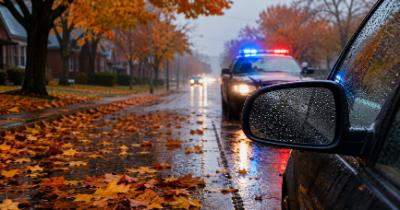
Falling leaves can affect a Buffalo traffic stop because they can change traction and make ordinary roadway features harder to see. Wet leaves can create slippery conditions, and accumulated leaves can cover lane markings, pavement defects, standing water, curb edges, or debris.
A police officer does not issue a ticket simply because leaves are on the road. The issue is usually the driving conduct that the officer believes occurred while those conditions were present.
A stop may follow an observation such as:
- Driving at a speed the officer believes was too fast for wet or leaf-covered pavement
• Following another vehicle too closely for the roadway conditions
• Drifting across a lane marking that was difficult to see
• Making an abrupt lane change or turn
• Failing to signal before moving around a road hazard
• Braking or swerving after noticing a hazard late
New York Vehicle and Traffic Law Section 1180 requires drivers to travel at a speed that is reasonable and prudent under existing conditions and hazards. It also requires an appropriately reduced speed when a special hazard exists because of weather or highway conditions. This means the posted speed limit is not the only factor that can matter when an officer evaluates speed.
Official New York law:
https://www.nysenate.gov/legislation/laws/VAT/1180
For information about common Buffalo traffic charges, visit:
https://www.arthurpressmanlaw.com/criminal-defense/traffic-violations/
Wet leaves and low visibility do not automatically prove a traffic violation. The exact charge, the officer’s observations, the roadway conditions, and other available evidence should be reviewed together.

Highly recommended Arthur pressman. I don’t live in Buffalo New York but while visiting my family there from Florida. I got pulled over while driving on a, suspended license in Florida. They arrested me and gave me a court date to appear in court and due to me living out of state I just could not afford to go back and forth to buffalo from Florida so that’s when I hired Arthur Pressman. He made sure to handle everything for me and kept me informed with what was going on. I received no points no penalties and the case was dropped. Thank you Arthur pressman your the best. Would definitely recommend you to family and friends.
Crystal B.
How Can Poor Visibility Lead to a Traffic Stop?
Poor visibility can lead to a traffic stop when an officer believes a driver did not adjust to conditions that limited sight distance. Rain can reduce windshield visibility. Fog and road spray can make vehicles, traffic signals, pedestrians, and lane markings harder to see. Low sun can create glare, and earlier darkness in the fall can reduce the distance you can see ahead.
New York DMV guidance advises drivers to reduce speed, increase following distance, and use additional caution in rain, fog, and other low-visibility conditions.
An officer may pay attention to whether you:
- Reduced speed as visibility decreased
• Increased the space between your vehicle and the vehicle ahead
• Stayed within your lane
• Signaled before changing lanes or turning
• Approached stopped traffic at a controlled speed
• Used headlights when required
• Responded safely to pedestrians, traffic signals, and road hazards
Equipment condition can also become relevant during a stop. Headlights, taillights, windshield wipers, and a clear windshield can affect what you can see and how visible your vehicle is to others.
New York DMV guidance on special driving conditions:
If a stop results in a traffic ticket, review:
https://www.arthurpressmanlaw.com/criminal-defense/traffic-tickets/
Related Videos
Will an Attorney Save Me Money?
Do I Need to Go to Court?
Can Wet Leaves Lead to a Speeding Ticket?
Yes. Wet leaves can be part of the factual context for a speeding allegation, especially when an officer believes the conditions required a lower speed.
Section 1180 does not limit the analysis to the posted maximum speed. It requires a reasonable and prudent speed under the existing conditions and hazards. It also calls for a reduced speed when weather or highway conditions create a special hazard.
That means a driver who is below the posted limit can still face an allegation that the vehicle was moving too fast for the conditions. Whether the evidence supports that allegation depends on the specific facts, including the roadway, visibility, traffic, speed evidence, officer observations, and the driver’s actions.
If speed is part of the charge, review:
https://www.arthurpressmanlaw.com/criminal-defense/speeding-tickets/
Can Wet Leaves Lead to a Following-Too-Closely Ticket?
Yes. Wet leaves and other roadway conditions can also be relevant to a following-too-closely allegation.
New York Vehicle and Traffic Law Section 1129 states that a driver must not follow another vehicle more closely than is reasonable and prudent, with consideration given to vehicle speed, traffic, and the condition of the highway.
A following distance that provides enough room on dry pavement may provide less margin when the pavement is wet or covered by leaves. If traffic slows suddenly and a driver brakes hard, swerves, or leaves the lane to avoid a collision, an officer may consider those events when deciding whether to issue a ticket.
A skid, hard brake, or sudden maneuver does not automatically prove that a driver violated Section 1129. Wet leaves, standing water, hidden pavement defects, unexpected traffic movement, and the actions of another driver can affect what happened.
Official New York law:
https://www.nysenate.gov/legislation/laws/VAT/1129
What Evidence Matters After an Autumn Traffic Stop?
Evidence after an autumn traffic stop can matter because road and weather conditions may change quickly. Leaves can be cleared, rain can stop, standing water can drain, and lighting conditions can change within a short period.
When it is safe and lawful to do so, preserve:
- Photographs or video of the road surface and leaf buildup
• Images showing visible or obscured lane markings
• Dash camera footage from before, during, and after the stop
• GPS or navigation history
• The exact time and location of the stop
• Notes about rain, fog, glare, road spray, or darkness
• Notes about traffic density and surrounding vehicles
• The officer’s apparent location and line of sight
• Names and contact information for witnesses
• Copies of every ticket, supporting deposition, and court notice
Keep original digital files whenever possible. Preserve the original photographs and video instead of replacing them with edited copies.
Your goal is to document the conditions that may help explain what the officer observed and what you could see from the driver’s seat.
Why Does the Officer’s Viewpoint Need Context?
The officer’s viewpoint needs context because a traffic ticket begins with an allegation, not a final determination that a violation occurred. The officer’s observations may be important, but other evidence can also help explain the driving conduct.
You may have been responding to an obscured lane marking, a pothole, a pedestrian, sudden braking ahead, glare, standing water, or another unexpected roadway condition. Dash camera footage, photographs, witness statements, and the layout of the road can help establish that context.
The exact charge also matters. A speeding allegation is different from an unsafe lane change, failure to signal, following too closely, failure to obey a traffic control device, or reckless driving allegation. If one stop results in several tickets, each charge should be reviewed separately.
If the allegation involves reckless driving, review:
https://www.arthurpressmanlaw.com/criminal-defense/reckless-driving/
What Should You Do After a Buffalo Traffic Ticket?
After a Buffalo traffic ticket, start by identifying the exact charge and the deadline for responding. Paying a ticket generally means entering a guilty plea, so you should understand the potential consequences before deciding how to proceed.
After the stop:
- Read the front and back of every ticket
• Confirm the exact Vehicle and Traffic Law section listed
• Identify the court or traffic agency handling the matter
• Calendar the response deadline and any appearance date
• Write down what happened while your memory is fresh
• Preserve dash camera footage before it is overwritten
• Save photographs, GPS records, and other relevant files
• Check whether more than one ticket was issued
• Review your driving record if prior convictions or points may matter
• Consider speaking with a traffic attorney before entering a plea
Do not miss a response deadline or required court date. Procedures can differ depending on where the ticket was issued, the court handling the case, and the charge involved.
A conviction for some traffic violations can result in DMV points. Depending on the violation and your driving history, a conviction can also affect your license status or insurance costs.
How Can a Buffalo Traffic Ticket Attorney Help?
A Buffalo traffic ticket attorney can review the charge, the available evidence, possible DMV point consequences, and the procedures that apply in the court handling your case.
A case review may include:
- The traffic ticket and supporting deposition
• The officer’s stated observations
• Road and weather conditions
• Visibility and lighting
• Speed measurement evidence, when applicable
• Dash camera or other video
• Photographs
• Witness statements
• Your driving record
• Other tickets issued during the same stop
Arthur Pressman has practiced in Buffalo since 1988 and focuses on DWI, traffic law, and criminal defense. His background is available here:
https://www.arthurpressmanlaw.com/attorney-profile/
No attorney can determine the proper strategy or predict a specific result without reviewing the facts, charge, evidence, and court involved.
Talk With a Buffalo Traffic Ticket Attorney
If falling leaves, poor visibility, rain, glare, or wet autumn roads played a role in your traffic stop, you can review the charge and evidence before deciding how to respond.
Arthur L. Pressman, Attorney at Law represents drivers in Buffalo, Williamsville, Erie County, Western New York, and nearby areas. He has practiced in Buffalo since 1988 and handles traffic, DWI, and criminal defense matters.
Call (716) 517-4250 to discuss your traffic ticket, or contact the firm here:
https://www.arthurpressmanlaw.com/contact-us/
This article is for general informational purposes only and is not legal advice. Consult an attorney about your specific situation.